


For a year I kept a folder of reels that had gone big in the dog corner of Instagram. Hundreds of them. I’d watch one, think *that’s clever*, save it, and move on.
I thought I was learning. I was collecting.
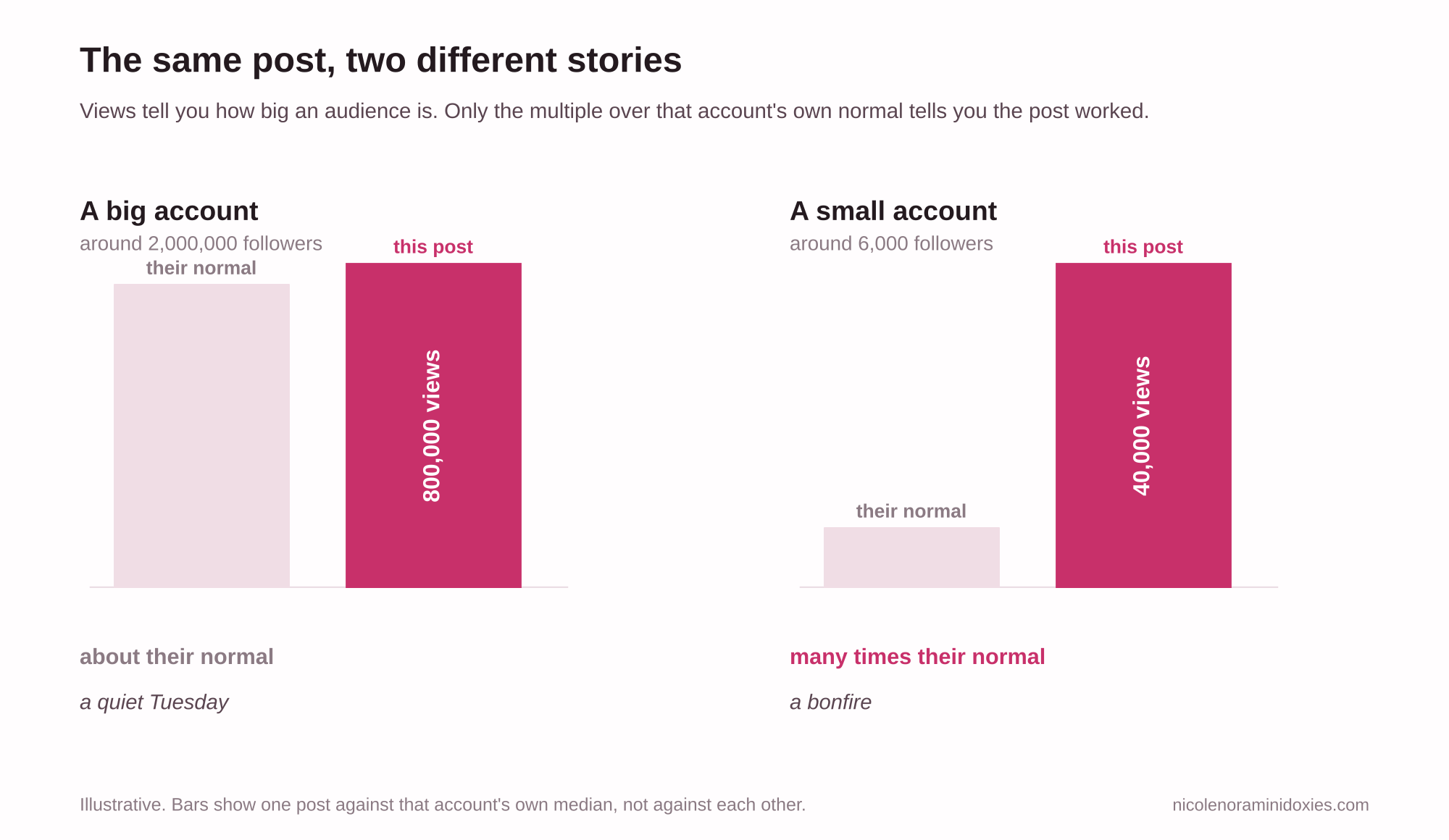
Here is the part that took me embarrassingly long to see. A reel with 800,000 views on an account with two million followers is not a hit. It might be that account’s quiet Tuesday. Meanwhile a reel with 40,000 views on an account with 6,000 followers is a bonfire, and I scrolled straight past it because the number looked small.
I was studying big accounts on their average days
Raw views tell you how big someone’s audience is. They tell you almost nothing about whether the *post* worked.
The only number that means anything is how far a post beat its own account’s normal. Three times that account’s median is a lesson, whoever posted it. One times is a Tuesday, even at two million followers.
Nobody does that maths by hand. So for a year I learned from the wrong posts, which is worse than learning from nothing, because I was confidently copying things that had never actually worked.
What fixed it
There’s a command you can install into Claude that goes and reads the reels in your niche, works out each account’s own median, and ranks what it finds by the multiple each post beat it by.
So the list it hands back is not “the biggest reels about dogs this month”. It’s “the posts that most outperformed what that account normally does”, which is a completely different list, and it is full of accounts your size.
Then it does the thing that turns a list into an education: for each one, it names the hook formula underneath it. Not “this did well.” *This did well, and here is the structure it used.*
Your swipe file stops being a graveyard of saved posts and starts being a pattern library.
And it runs the same maths backwards over your own published posts, which is the uncomfortable one. You find out which of your reels were genuine outliers versus the ones you simply enjoyed making. Those two sets overlap less than you’d like.
The rest of it, briefly
The same setup does the jobs around that one. It’ll take an idea and write you three hooks off named formulas, score them, and rank them. It writes the script, the on-screen text, and a beat sheet with timings, so it can tell you your hook runs too long before you’ve filmed it badly. It scores your profile against a twelve-part rubric. It lints a caption and shows you the ~125 characters that show before the “more” tap. It strips the invisible characters and stock phrasing out of anything AI touched.
Nothing in it posts, comments, follows or DMs. It writes, you post. My two dachshunds Nicole and Nora are the whole product here, and no algorithm is picking which photo of Nora mid-sneeze represents us.
And if you’d rather just watch the girls be spectacularly unhelpful about all of this, we’re on Instagram, TikTok and YouTube.
That’s the idea that changed how I read my feed. What it is, where to get it, how to run it, and the number that shows where it fails are below. 🔒
Inside the paid half, you’ll get:
🔗 The exact thing, and the link to install it, free and open source
🔍 How to run the outlier search properly, and what to do with what comes back
🪞 The same maths pointed at your own posts, and how to read the result without flinching
⚙️ The five-minute setup, including the step everyone skips
🗣️ My voice file, written out as a fill-in template you can paste straight in
📉 The author’s own test results, including the one where it barely beats a coin toss
🎁 30% off The Petfluencer Playbook, paid subscribers only
📚 Every paid post plus the full archive
Come join me on the inside 👇
