The Petfluencer Playbook

The Petfluencer Playbook

How I Grew My Pet Accounts to ~70k: My Step-by-Step System

The whole climb, stage by stage: how I started, found my angle, and grew ~12k on Instagram, ~15k on TikTok, and ~43k on YouTube 🐾

The Petfluencer Playbook's avatar
The Petfluencer Playbook
Jul 01, 2026
∙ Paid

Hi — it’s Iana, the human behind Nicole & Nora, my two miniature dachshunds and the entire reason my phone storage is permanently full. People ask me the same question more than any other: “How did you actually grow to ~70k? Like, what did you do — in order?”

So today I’m writing the post I wish someone had handed me on day one. Not vague “post consistently and engage!” advice — the actual sequence. The stages I went through, what I posted in each one, the things that worked, the things that flopped loudly, and exactly how you’d copy each step for your own account. This is the flagship one. Save it. 🐾

New here? Come meet the girls where it all actually happens — we're on Instagram, TikTok, and YouTube. 🐾

First, the honest truth about the curve

Everyone wants the growth to look like a rocket. Mine looked like a dachshund climbing stairs — slow, a little dramatic, then suddenly faster than you expect. The total is real; the shape below is illustrative, but it’s emotionally accurate:
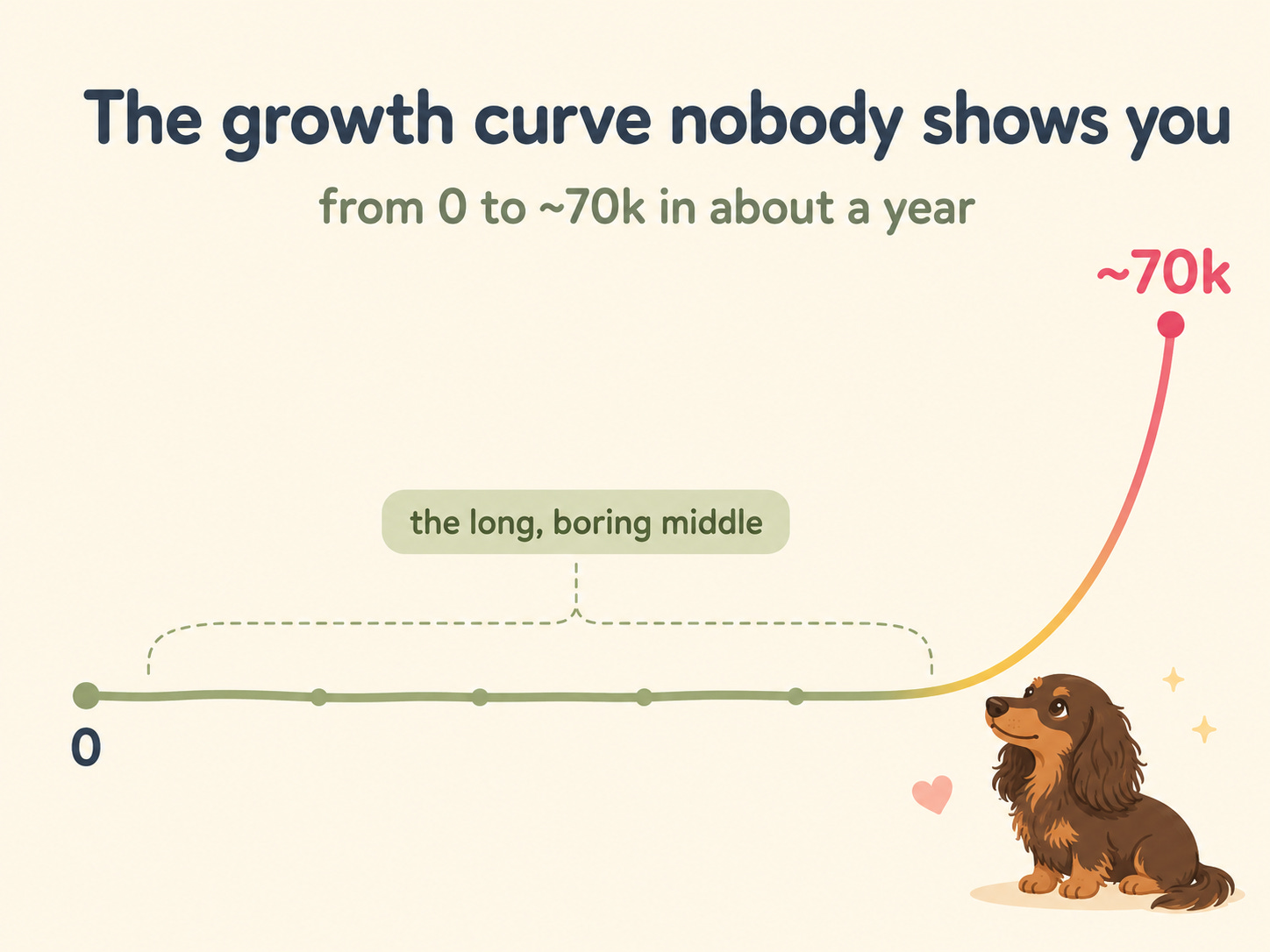
Illustrative growth curve for a pet account: nearly flat through the long, boring middle, then rising steeply from 0 to about 70k in roughly a year.
My pet account growth curve from zero to ~70k followers across Instagram, TikTok, and YouTube.

The part nobody likes to hear: the first stretch is boring on purpose. The accounts that make it aren’t the ones that went viral on day three — they’re the ones that survived the flat part long enough to reach the snowball. I almost quit twice in the flat part. I’m so glad I didn’t.

Before the how, two honest gut-checks are worth doing first: which pet niches actually pay, and what a realistic first $1,000 looks like. If you want the whole picture in one place, it lives in the honest guide to becoming a pet influencer.

The shape of the whole system: five stages

Here’s the thing I figured out way too late: you’re not trying to “grow an account.” You’re trying to climb five very different stages, and each one needs a different kind of posting. What grows you at Stage 1 will quietly stall you at Stage 3. I think most people get stuck because they keep doing Stage 1 things forever and wonder why the ladder isn’t moving.

The five stages, top-line:

  • Stage 1 — Start small: pick one clear angle and just begin.

  • Stage 2 — Post daily: find out what actually sticks.

  • Stage 3 — Double down: repeat your winners, kill your darlings.

  • Stage 4 — Go multi-platform: one shoot, three platforms.

  • Stage 5 — Scale & earn: series, collabs, and turning attention into income.

That’s the map. The free version gives you the what and the why of each stage. The paid version below is the real thing — what I posted at each stage, the flops, the tools, the illustrative money math, and exactly what I’d do if I were starting again today with zero followers.

Stage 4 leans hard on a system I’ve already shared — if you want the engine that makes one filming session feed every platform, I broke the whole thing down in my post on our faceless content workflow. It pairs perfectly with this one. 🐾

More from the Playbook: how to become a pet influencer from scratch, and our faceless content workflow.

🐾 Helping animals is the whole reason we’re here. If you’d like to help too, you can chip in to our shelter fundraiser for Animal Haven. Every little bit helps an animal in need. Join us. 💗

Help a shelter dog

The payoff: the whole climb, stage by stage

Okay — here’s everything. Read it once top to bottom, then come back and work the stage you’re actually in. Here’s the ladder we’re climbing:

The five-stage system for growing a pet account, shown as a rising staircase: 1. start small, 2. post daily, 3. double down, 4. go multi-platform, 5. scale and earn.
My five stages to grow a pet account: start small, post daily, double down, go multi-platform, scale and earn.

First — how long this actually took

Before the stages, the question I get more than any other: how long did this take? So here’s the honest answer: about a year — roughly twelve months from zero to ~70k, no rounded-up fairy tale. The four milestones below are the ones that matter for every account; I’ve marked roughly how long each leg took me so you can gut-check your own pace against a real one. Your timing will differ, but the shape almost never does.

Timeline of growing a pet account over about twelve months in three legs: 0 to 1,000 the quiet start, 1,000 to 10,000 the grind, 10,000 to about 70,000 the snowball
About twelve months from zero to ~70k: a slow quiet start, then a compounding grind, then the snowball.

0 → 1,000 — “the quiet start” (the slowest leg by far). This was the longest-feeling leg by far, even though the number is small. Almost nobody was watching, and that’s exactly the filter — most people quit right here. What moved the needle wasn’t reach, it was finally narrowing my angle so the few people who found me had a reason to stay.

1,000 → 10,000 — “the grind” (steady and compounding). This is where posting daily and watching my data paid off: two or three formats started consistently out-saving everything else, and repeating them (instead of chasing new ideas) is what finally bent the curve upward. Steady, unglamorous, compounding.

10,000 → ~70,000 — “the snowball” (the fastest stretch). The fastest leg — and the surprise is where it came from: YouTube, now ~43k of my total, which I nearly ignored. Going multi-platform with the same footage is what turned a single audience into three that fed each other.

The pattern I’d tattoo on every beginner: the first leg is slow on purpose, and the later legs are faster than you’d ever believe from inside the flat part. The people who make it aren’t faster climbers — they just don’t quit during “the quiet start.”

Stage 1 — Start small (pick ONE angle)

What it is: the deceptively simple act of choosing a single, clear angle and posting your first things. Why it matters: a confused page can’t grow. When I started, my page was “cute dog, generally” — which is the same as everyone else’s. Nothing happened for weeks, and honestly it deserved nothing.

The flop: my early posts were random — a sunset here, a half-blurry zoomie there, captions like “happy Monday!” There was no reason to follow. The fix that worked: I narrowed to one specific thing — two miniature dachshunds and the very particular comedy of their loaf-shaped daily life. Specific beats broad every single time. “Mini dachshund chaos” is a follow; “dog content” is a scroll.

What I’d actually do today: finish this sentence before you post anything — “My page is about ___, for people who ___.” Then post your intro: a “meet the girls” reel, your name reveal, and three posts that prove the angle. Keep a one-page brand note (name, voice, three content pillars) in Canva so every post stays on-angle. (Results vary — but clarity compounds.)

Stage 2 — Post daily (find what sticks)

What it is: a deliberately high-volume stretch where the goal isn’t growth — it’s data. Why it matters: you do not actually know what your audience wants yet. You think you do. You’re usually wrong (I was). The only way to find your winners is to put a lot of different shots on the table and watch which ones people save and share.

The honest catch: this stage is tiring, and the numbers stay flat for a while. That’s normal — you’re in the boring part of the curve. Watch saves and shares, not likes. Likes are a pat on the head; saves and shares are the algorithm’s love language and the truest signal of what’s working. What I’d actually do: post once a day for ~30 days, vary the format on purpose (funny clip, calm aesthetic, relatable POV, tiny tutorial), and keep a simple note of which three posts outperformed. Don’t batch-burn yourself out — a sustainable cadence you can keep beats a heroic week followed by silence.

Stage 3 — Double down (repeat winners, drop flops)

What it is: the stage where you stop guessing and start repeating. This is the single move that pulled me out of the flat part. Why it matters: by now your Stage 2 data has shown you two or three formats that consistently out-save the rest. Most people see a hit, feel proud, and then... post something completely different the next day. That’s the mistake. A winner isn’t a one-off — it’s a template.

What I actually did: my “Nora dramatically refuses to get out of bed” clip did 4x my normal reach. So I made it a recurring bit. Same setup, different day, slightly different gag. Each one performed because the audience already knew the joke and wanted the next episode. How it scales: turn every winner into a series with a repeatable hook. The catch: repeating isn’t copy-pasting — keep the format, refresh the moment, or it goes stale. What I’d do: list your top 3 posts of the last month and ask of each, “what’s the series version of this?” Then make episode two.

What to post at each growth stage: 1. start small — your intro loaf post; 2. post daily — quick daily clips; 3. double down — trend audios that worked; 4. go multi-platform — faceless tutorials; 5. scale and earn — series and collabs.
What I posted at each stage to grow — intro loaf, daily clips, trend audios, and faceless tutorials.

Stage 4 — Go multi-platform (one shoot, three homes)

What it is: taking the winning formats you found and giving them three homes — Instagram, TikTok, and YouTube — without tripling your work. Why it matters: this is where my ~70k actually came from. YouTube is ~43k of my total — by far the biggest — and I almost ignored it because “everyone’s on TikTok.” Each platform reaches different people and rewards slightly different things, so the same dog content compounds across three audiences instead of one.

How it works in practice: film once, then slice. A single clip becomes a vertical Reel/TikTok and a YouTube Short; a batch of stills becomes a carousel; the longer cut becomes a real YouTube video. I run this off one weekly session — the full method (shot list, the “one clip → three hooks” trick, the 7-day calendar) is in my faceless content workflow post. The catch: don’t post the identical file everywhere on the same day and call it a strategy — tweak the hook and the caption per platform. Tools I use: I edit and reframe in CapCut, auto-repurpose long clips into shorts with OpusClip, schedule across platforms with Buffer or Later, and keep one tidy link-in-bio with Linktree or Beacons. (Tools, not magic — results vary.)

That’s Stages 1 through 4 — the whole growth engine, in full and free. Stage 5 is where a warm, real audience finally turns into income.

Inside the paid half, you’ll get:

🥇 Stage 5 in full — series, collabs, and the moves that turn attention into money

💸 the honest money math (illustrative) — what an audience like this can realistically earn

🔁 the one boring habit underneath all five stages

🎁 30% off The Petfluencer Playbook, paid subscribers only

📚 every paid post plus the full archive

Come join me on the inside 👇

User's avatar

Continue reading this post for free, courtesy of The Petfluencer Playbook.

Or purchase a paid subscription.
© 2026 Nicole & Nora · Privacy ∙ Terms ∙ Collection notice
Start your SubstackGet the app
Substack is the home for great culture