

The email I was not ready for. A brand emailed us and asked, very casually, “Can you send over your media kit?”
A quick note: some links in this post are affiliate links, so parts of it are #ad. If you use one I may earn a little at no extra cost to you, and I only mention tools I actually use.
I did not have a media kit. What I had was a folder called final_FINAL_v3 and a very strong feeling that I was about to be found out. So I did what a lot of pet creators do when they build a first pet media kit: I opened Canva, picked the prettiest template, and spent most of a Saturday making eight gorgeous pages while my two dachshunds Nicole and Nora slept on my feet in a single unmoving loaf.
I sent it. Then nothing. Not a no. Just the particular silence that makes you refresh your inbox like it owes you money.
It took me a long time and several more silences to understand what actually happened. My media kit was not too ugly. It was not too small. It was answering questions nobody at that company had asked.
Last time, I broke down the one sentence that makes brands actually “get” your pet page, the line that turns a cute account into something they can pitch internally. If you missed it, start here →
Nobody reads your pet media kit. They scan it and defend it.
Here is the thing I wish someone had told me before that Saturday.
The person opening your pet media kit is not a fan. They are usually a junior marketing coordinator with forty other kits open, a spreadsheet, and a boss who is going to ask them one question: why her?
They are not evaluating your aesthetic. They are gathering ammunition. Everything on your kit is either a bullet they can use in that conversation, or it is furniture.
Which reframes the whole document. A media kit is not a portfolio. A media kit is a one-page argument that a stranger can repeat out loud to their boss without you in the room.
Once I understood that, my eight beautiful pages became obviously, painfully wrong. Page one was a photo of my dogs. Page two was our “story.” Page three was a follower count. None of those are arguments. They are furniture.
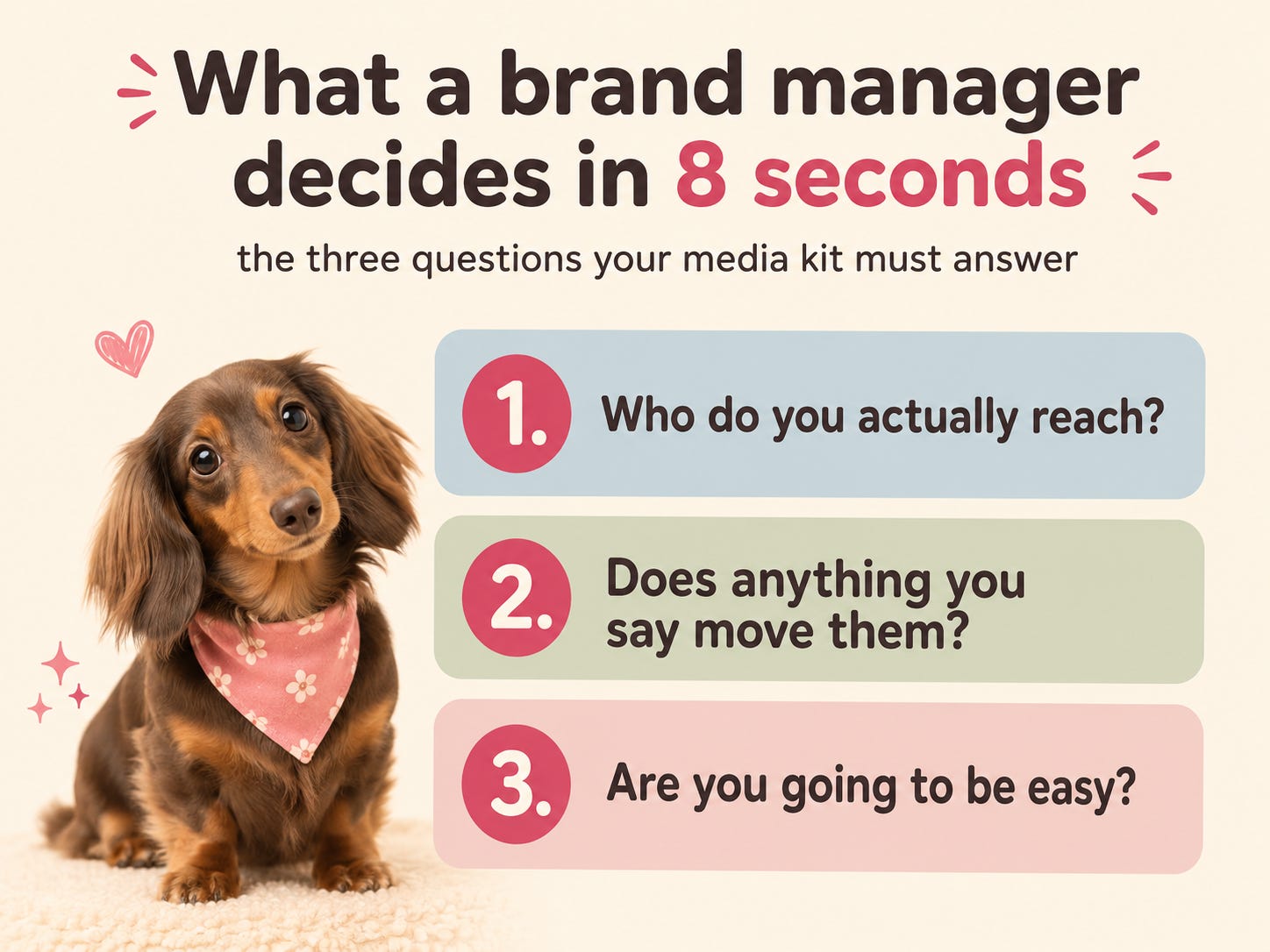
The three questions your kit has to answer
Every brand conversation I have been in since, paid or not, has come down to the same three questions. They are never asked directly. They are always being answered.
1. Who do you actually reach? Not how many. Who. “12k followers” is a number. “Mostly women 25 to 40 in US cities who own a small dog and buy for it like it’s a toddler” is a person their product is for. One of those goes in a spreadsheet. The other one gets repeated in a meeting.
2. Does anything you say move them? Reach is a claim. Engagement is evidence. A brand has been burned before by a big account that sold nothing, and they are quietly terrified of it happening again on their budget.
3. Are you going to be easy? This one is invisible and it decides more than the other two. Every brand has worked with a creator who missed the deadline, ignored the brief, forgot the disclosure, and made them look bad internally. Your kit is their first read on whether you are that person.
Here is your free takeaway, and it is the one that changed things for me: go look at your current media kit and ask which of those three questions each block answers. Anything that answers none of them is decoration. On my eight-pager, six pages were decoration. Once I cut them, the whole thing fit on one page, and that is when it started working.
The one-page rule is not about attention spans. It is about forcing you to choose. A page you cannot cut is a page you have not thought about.
If you want the sentence that goes at the very top of that page, I broke down the exact structure in the one-line fix that makes brands “get” your page. That sentence and this kit are the same argument at two different lengths.
Related, and free: why brands scroll past your page, and how pet influencers get paid.
🐾 Helping animals is the whole reason we’re here. If you’d like to help too, you can chip in to our shelter fundraiser for Animal Haven. Every little bit helps an animal in need. Join us. 💗
💬 Tell me in the comments: has a brand ever asked you for a media kit and you panicked? I need to know I was not the only one refreshing that inbox.
And if you want to see the account all of this came from, we’re over on Instagram, TikTok, and YouTube. Two dachshunds, zero shame.
Knowing the three questions is the easy part. Actually building the page is where everyone stalls, because the internet will tell you to make it pretty and will not tell you what goes in which block, or in what order.
So below, I’m doing a full teardown of my own one-page kit, block by block, in the exact order a brand reads it.
That's why kits get scanned in four seconds, and the three questions yours has to answer. The teardown itself, block by block, is on the other side. 🔒
Inside the paid half, you'll get:
🐾 My one-page kit pulled apart block by block, identity line to money line
The 8-point scorecard to grade your kit before you send it again (mine scored 2)
The fill-in-the-blank kit you can copy line by line and have finished tonight
The exact places to send it, the marketplaces and networks I would actually use
What I would do differently if I were starting today with zero
Plus 30% off the $29 Petfluencer Playbook, paid subscribers only
And every paid post + the full archive
Come join me on the inside 👇
